
Zero Budget Natural Farming
Introduction:
Zero budget natural farming is the farming system in which we do farming without use of
synthesised fertilzers or without spending money on purchasing fertilizers , pesticides and
seeds. Crops are grown by natural methods. All inputs are to be locally resourced from in
and around the village. ZBNF is purposed by Indian agricultural scientist Mr.Subash Palekar.
A popular incident is his interaction with farmers (women self-help group members) almost
10 to 15years earlier (circa 2005) as part of Velugu initiative under Society for Elimination of
Rural Poverty. The two sides did not understand each other’s language (Mr Palekar spoke
Marathi, Hindi or English) and the women SHG members understood only Telegu), but a
common medium for them was agriculture that they both understood and the event was was
appreciated. One of the participants went back home and had a discussion (rather, argument)
with her husband of trying this method of agriculture without use of pesticides and fertilizers.
The husband was furious, but finally they agreed that the wife can try the alternative method
in half a plot while in the other half the husband would continue with his application of
fertilizer and pesticides. The outcome was that the yield was not much different between the
two approaches, but the wife’s approach had a much lower cost. In the next season the couple
used this zero budget natural farming approach in all their plots and now the whole village
was watching and they all shifted to this approach in the third season (Mishra and Reddy,
2011). This is a classic case of a real life application of the case-control method.
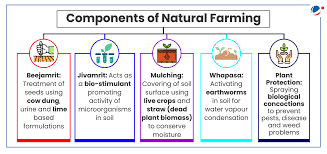
Four Pillars of ZBNF
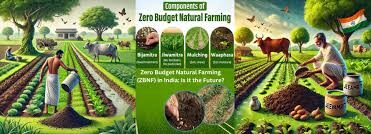
1. Jivamrut 2. Bijamrit 3. Acchadana/ Mulching 5. Whapasa/Moisture
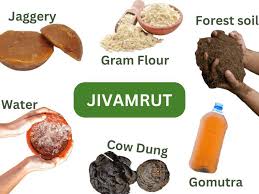
Jivamrita:
Jeevamrit is a organic manure .This is fermented microbial culture which is prepared by
natural resources. Jeevamrit helps to increase the microbial activity in the soil . The
48hrs. fermentation process multiplies aerobic and anerobic bacteria present in the cow
dung and urine , as they eat organic integredients and a handful of undistributed soil acts
as inoculate of native species of microbes and organisms. It can be applied through
irrigation water or foliar spray. While transiting from conventional input-intensive
agriculture, the application of Jeevamrutha to the soils and plants is required only for the
first three years because after that the system becomes self-sustaining.
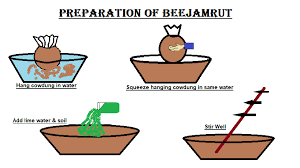
Bijamrita:
This is a organic manure which is prepared from locally available natural resources for
the propose of treatment for seeds, seedlings or any planting material. It reduces the
possibility of seed infestation by pests and protects young roots from fungus, soil-borne
diseases, and seed-borne diseases that generally affect the plants after monsoon. In the
ingredients, the dung and urine from the indigenous breed cow act as a powerful
fungicide, and anti-bacterial agent, respectively.
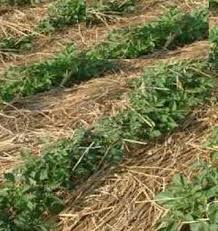
Acchadana/Mulching:
There are three types of mulching.
Soil mulching: It protects topsoil by avoiding tilling. It facilitates aeration, and
promotes water retention.
Straw/Biomass mulching: Application of dry organic matter (dead material of any
living being) along with Jeevamrutha will lead to decomposition and humus
formation that will improve soil fertility.
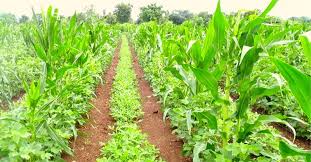
Live mulching: This suggests inter-cropping or mixed-cropping by combining
monocots (those seedlings with one seed leaf like rice and wheat) with dicots
(those seedlings with two seed leaves like legumes) in the same plot of land. This
will create a symbiotic relationship because monocots will supply elements like
potash, phosphate, and sulphur, while dicots will work towards nitrogen-fixation .
Whapasa/Moisture:
It is the condition where there are both air molecules and water molecules present in the soil.
Thereby helping in reducing irrigation requirement.
Other important principles of ZBNF :
Intercropping – Because of this, ZBNF gets its “Zero Budget” name. small costs
incurred in cropping is compensated by the additional income, making farming a
close to zero budget activity. Crop and tree associations work well for the south
Asian context.
Contour bunds –contours bunds promote maximum efficiency for different crops.
Local species of earthworms: Revival of local deep soil earthworms through
increased organic matter is most recommended than vermicompost (the Eisinea
feotida worm, exotic to India should be avoided), and to use the indigenous humped
cow (Bos Indicus) for their dung and urine because they have a greater concentration
of micro-organisms.
Cow dung- Dung from the Bos indicus (humped cow) is most beneficial and has the
highest concentrations of micro-organisms as compared to European cow breeds such as Holstein. The entire ZBNF method is centred on the Indian cow.